Teaching Kindness When Others Are Cruel
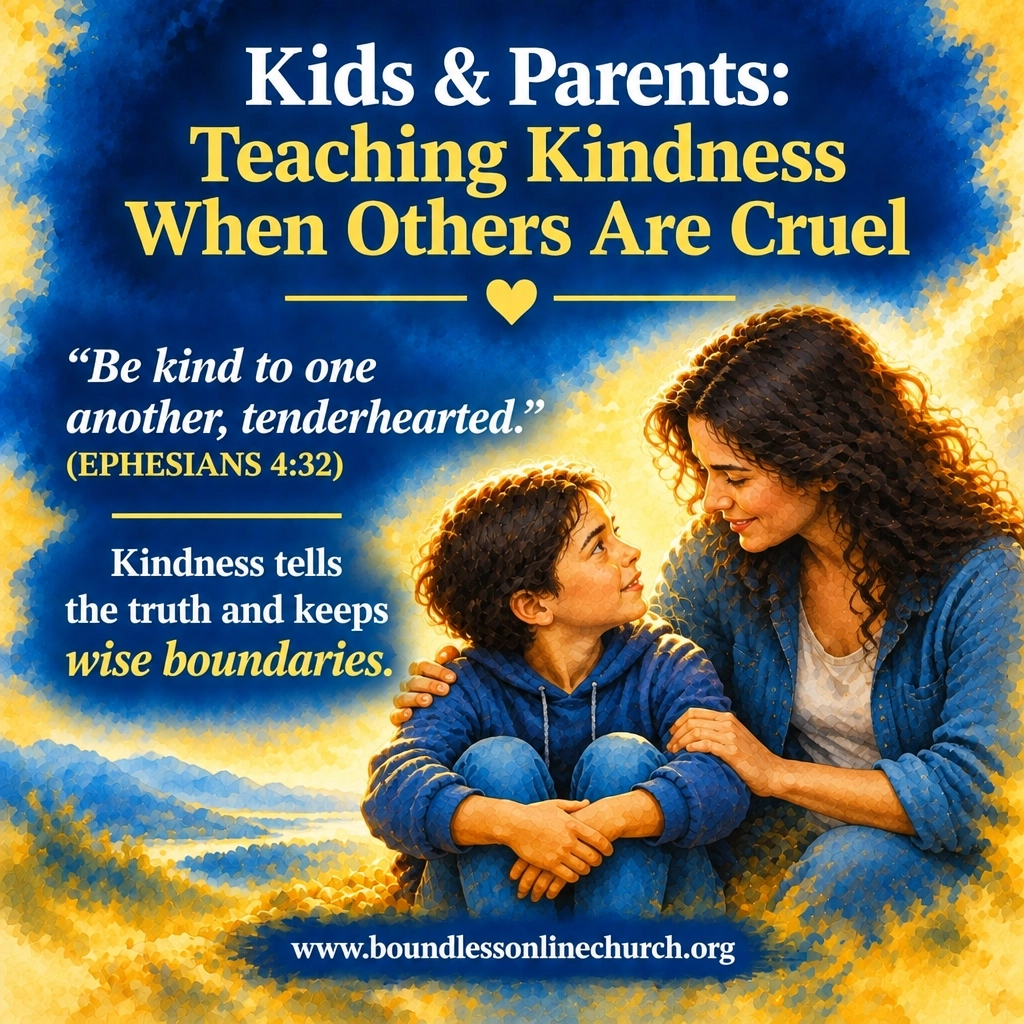
Teach your child that biblical kindness is not weakness. It is a brave, Spirit-shaped response that tells the truth, keeps wise boundaries, refuses revenge, and seeks help when harm continues.This refreshed guide will help parents teach children how to respond to cruelty with grace, courage, and clarity. You will find Scripture, practical phrases, simple boundary tools, prayer support, and next steps that help your family follow Jesus in hard social moments.When another child is cruel, your chil
Teach your child that biblical kindness is not weakness. It is a brave, Spirit-shaped response that tells the truth, keeps wise boundaries, refuses revenge, and seeks help when harm continues.
This refreshed guide will help parents teach children how to respond to cruelty with grace, courage, and clarity. You will find Scripture, practical phrases, simple boundary tools, prayer support, and next steps that help your family follow Jesus in hard social moments.
When another child is cruel, your child may feel embarrassed, angry, afraid, or deeply confused. They may wonder whether being kind means staying quiet, acting like nothing happened, or continuing to stand in the path of hurtful behavior. Scripture offers something stronger and safer than that. In Christ, kindness and wisdom belong together.
What Christian Kindness Really Means for Children
Many children hear the instruction, “Be nice,” but they need more than a vague command. They need to understand what Christian kindness looks like when someone is mocking, excluding, insulting, manipulating, or hurting them.
Biblical kindness means treating another person as someone made in the image of God. It may include speaking gently, refusing revenge, telling the truth, offering forgiveness, or noticing someone who feels alone. But kindness does not require your child to approve of harmful behavior or remain close to someone who repeatedly mistreats them.
Jesus taught His followers to love their enemies and pray for those who persecuted them (Matthew 5:44). He was not teaching passivity. Throughout the Gospels, Jesus showed compassion toward hurting people, confronted hypocrisy, withdrew from threats when necessary, and spoke truth with courage.
Your child can learn the same pattern: a soft heart, a truthful voice, and wise boundaries.
What the Bible Says About Kindness Under Pressure
The Bible does not present kindness as a personality trait reserved for naturally gentle people. It presents kindness as part of the life the Holy Spirit forms in us.
In context, Paul is contrasting life shaped by the flesh with life shaped by the Holy Spirit. Kindness is not simply a child’s temperament or a parent’s success. It is evidence of God’s work in a person’s heart. Parents can teach kindness while also praying for the Holy Spirit to give their children strength they cannot produce on their own.
Paul also writes, “Be kind to one another, tenderhearted, forgiving one another, as God in Christ forgave you” (Ephesians 4:32). This instruction sits inside a larger passage about putting away falsehood, anger, corrupt speech, bitterness, and malice. Biblical kindness is active and truthful. It replaces destructive patterns with words and actions that bring grace.
Romans 12:17–21 gives another important foundation. Believers are told not to repay evil for evil, to pursue peace where possible, and to overcome evil with good. This does not mean pretending evil is harmless. It means refusing to let another person’s sin control your child’s character.
How to Teach Your Child Kindness When Others Are Mean
1. Listen Before You Correct
When your child tells you that someone was cruel, begin with presence rather than immediate instruction. If your first response is, “You need to forgive them,” your child may quietly conclude that their pain is inconvenient or unimportant.
Try saying, “I am glad you told me,” “That sounds painful,” or “You did not deserve to be treated that way.” Listening does not mean you are declaring your child perfect or deciding the entire situation in one moment. It means you are creating a safe place for truth.
Ask gentle questions:
Children often need help finding words for confusing experiences. A calm conversation helps you understand whether your child encountered a single unkind moment, a broader conflict, or a repeated pattern that requires adult intervention.
2. Teach the Difference Between Kindness and Weakness
Some children assume that kindness means absorbing pain without speaking up. Others assume that strength means being harsh back. Neither picture is biblical.
Kindness is not weakness. Kindness is strength under the rule of Christ. It refuses revenge, but it also refuses silence when truth needs to be spoken. It values both compassion and wisdom.
You can tell your child, “We do not answer cruelty with cruelty, but we also do not pretend cruelty is okay.” That sentence gives children a framework they can remember in school, online, on a team, or inside a friend group.
3. Separate the Person From the Harmful Behavior
Teach your child that a person’s behavior can be wrong without declaring that the person has no value. This distinction helps children resist both hatred and naivety.
You might say, “What that child did was cruel, but we will not decide that they are worthless. Every person is made by God. We can oppose harmful behavior without becoming hateful people ourselves.”
This reflects the biblical pattern of speaking truth while preserving human dignity. It also helps your child avoid labels such as “evil,” “stupid,” or “hopeless,” which can make anger harder to release.
Compassion does not excuse cruelty. Sometimes a child acts harshly because of insecurity, pain, peer pressure, or poor examples. Understanding possible reasons may help your child pray with compassion, but it should never be used to minimize harm or blame the child who was mistreated.
4. Give Your Child Calm Words to Say
Children are more likely to respond wisely when they have practiced what to say before a difficult moment occurs. Keep the phrases short enough to remember and steady enough to use under stress.
These statements are not rude. They are clear, calm, and protective. A child does not need to win an argument or deliver a perfect speech. The goal is to communicate truth without returning insult for insult.
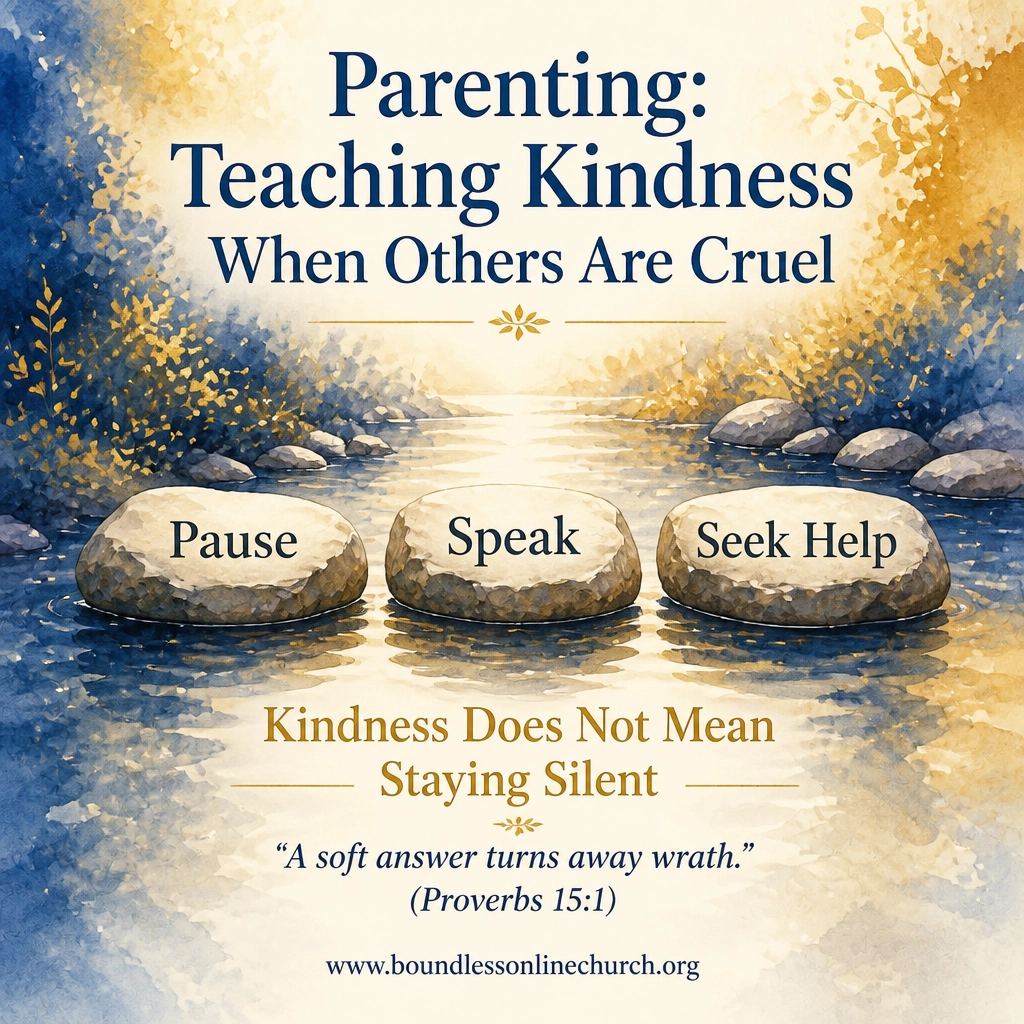
Proverbs 15:1 says, “A soft answer turns away wrath, but a harsh word stirs up anger.” In context, this wisdom teaches that our words can either lower the temperature of conflict or intensify it. A soft answer is not a weak answer. It is a controlled answer that refuses to add more heat.
5. Practice the Pause Before the Response
Cruelty often creates a fast emotional reaction. A child may want to shout, push, post something hurtful online, or recruit friends to retaliate. Teach a simple pause: stop, breathe, pray, and choose.
You can practice this rhythm at home:
This is not about suppressing emotion. Anger can alert your child that something is wrong. The goal is to keep anger from becoming the driver of the next decision.
Role-play helps children discover that kindness is not merely an idea discussed during peaceful moments. It is a response they can rehearse for real life.
6. Teach Forgiveness and Boundaries Together
Children often need help understanding forgiveness. Forgiveness does not mean saying that cruelty was acceptable. It does not require immediate friendship, restored access, or the removal of every consequence.
Forgiveness means releasing personal vengeance to God and refusing to make revenge the center of the heart. Trust, however, is rebuilt through repentance, changed behavior, accountability, and time. A child may forgive someone while still choosing distance and asking adults to establish appropriate boundaries.
You might say, “We can ask Jesus to help us forgive, and we can also make wise choices about who is safe to be around.” This language protects your child from two unhealthy extremes: clinging to hatred or offering unlimited access to someone who has not changed.
Jesus calls us to love people, but love is not the same as enabling. Love seeks what is truly good, and sometimes what is good includes accountability, distance, correction, or intervention.
7. Teach Your Child When to Get Adult Help
A child should never be taught that Christian kindness means handling every painful situation alone. Seeking help can be an act of wisdom and courage.
Teach your child to involve a trusted adult when cruelty is repeated, threatening, humiliating, physical, sexual, discriminatory, or difficult to stop. Depending on the setting, that adult might be a parent, guardian, teacher, school counselor, youth leader, coach, or another responsible caregiver.
Help your child report facts clearly:
Teach them not to exaggerate, retaliate, or spread the story to everyone. Truthful reporting protects people and makes it easier for responsible adults to respond well.
Kindness may mean praying for the person who caused harm. It may also mean telling the truth so the harm does not continue. Both can be expressions of love.
8. Model Kindness in Your Own Conflicts
Children learn how to respond to cruelty by watching how adults respond to frustration. They notice the way you speak about a difficult relative, react to an unfair experience, answer a harsh message, or discuss someone who disappointed you.
You do not need to pretend that rude behavior does not affect you. Instead, model a faithful process: “That comment hurt me, and I feel angry. I want to answer harshly, but I am going to take a moment and ask Jesus for self-control.”
When you make a mistake, let your child see you apologize. A humble apology teaches more about grace than a long lecture about perfect behavior.
If your family is learning to build spiritual habits at home, the Boundless article How Do I Raise Kids Who Love Jesus in a World Full of Screens? offers more help for intentional discipleship.
You may also find encouragement in How Do I Pray When I Feel Overwhelmed?, How Do I Set Healthy Boundaries Without Feeling Guilty?, and What Does God Do With My Anxiety?. If your child needs ongoing prayer, you can also share a request on the Prayer Wall.
9. Help Your Child Notice the Child Who Is Left Out
One of the most practical ways to grow kindness is to teach children to notice people who are overlooked. They can greet someone who is often alone, invite a classmate into a game, sit beside someone new, encourage a sibling, or speak up when a group begins excluding someone.
Do not turn this into pressure to rescue everyone. Instead, help your child look for one faithful opportunity at a time. Ask, “Who might need encouragement today?” or “Where did you notice someone being left out?”
Kindness becomes a way of seeing. It trains children to look beyond popularity, appearance, ability, background, or social status and recognize the dignity of another person.
What If My Child Has Been the One Acting Cruelly?
Sometimes the child who is hurt is also the child who has hurt someone else. Christian parenting makes room for both compassion and repentance.
Begin by listening without defensiveness. Help your child name what happened, identify the impact of their actions, and take responsibility without collapsing into shame. There is a difference between saying, “I did something unkind,” and “I am permanently a bad person.”
Guide your child toward a sincere apology that does not make excuses. A meaningful apology may include:
Ephesians 4:32 points children toward forgiveness because God has shown forgiveness in Christ. Grace does not remove responsibility. It gives children hope that failure does not have to become their identity.
For more help with honest family conversations, read What Should I Do When My Teen Doubts God? and keep building your family’s support through the Bible Study Club.
How Parents Can Keep the Kindness Conversation Going at Home
Do not wait for a crisis to talk about kindness. Build small conversations into ordinary life.
At the end of the day, ask, “Where did you see kindness today?” You can also ask, “Was there a moment when kindness was difficult?” and “What would you like to try next time?”
Read a short Bible passage together, pray for someone who is difficult to love, or share a story about a time you needed forgiveness. Keep the conversation age-appropriate. Younger children may need a simple sentence and a role-play. Older children may need space to wrestle with justice, peer pressure, online cruelty, and the fear of standing alone.
The goal is not to raise children who are endlessly agreeable. The goal is to raise disciples of Jesus who can recognize evil without becoming evil, speak truth without contempt, forgive without pretending, and seek help without shame.
Boundless also offers a place for families to keep growing through the Bible Study Club and the Prayer Wall. Christian formation is not meant to happen in isolation.
A Short Prayer for Parents and Children
Jesus, please give our children tender hearts and courageous spirits. Help them respond to cruelty without becoming cruel. Give them wisdom to speak truth, strength to walk away from harmful behavior, and humility to seek help when they need it. Let Your Holy Spirit grow kindness, goodness, gentleness, and self-control in them. Help us model the grace and courage we want them to learn. Amen.
Frequently Asked Questions About Teaching Kindness to Children
How do I teach my child to be kind without being a pushover?
Teach your child that kindness and boundaries belong together. They can speak respectfully, refuse revenge, pray for someone, say “stop,” walk away, limit contact, and tell a trusted adult. Christian kindness never requires a child to accept ongoing harm.
Should my child forgive a kid who keeps being mean?
Your child can begin the process of forgiveness by releasing revenge to God, but forgiveness does not mean immediate trust or continued access. Repeated harmful behavior should be addressed by responsible adults. Trust grows through changed behavior, accountability, and time.
What should my child say when another child is cruel?
Give your child short phrases such as, “That was not kind. Please stop,” “I will not speak to you that way,” or “I am going to get help.” Practice saying these words calmly, then teach your child to walk away and tell a trusted adult if the behavior continues.
How can Christian parents help a child handle online cruelty?
Teach your child not to reply in anger, forward hurtful messages, or organize retaliation. They can pause, save relevant information, block or report the account when appropriate, and tell a trusted adult. Pray with them and remind them that cruel words do not define their identity in Christ.
What Bible verses help children learn kindness and boundaries?
Helpful passages include Ephesians 4:32, Galatians 5:22–23, Proverbs 15:1, Romans 12:17–21, Luke 6:31, and Matthew 5:44. Read each one in context and connect it to a specific action your child can practice this week.
Text us for prayer at 901-213-7341 or visit www.boundlessonlinechurch.org.
Read our Privacy Policy and Terms & Conditions.
www.boundlessonlinechurch.org
#biblestudy #parenting #family #faith #prayer #discipleship #grace #mentalhealth