
Wednesday Wonder: The Miracle of the Human Eye
- Boundless Team

- Feb 26
- 6 min read
Have you ever stopped to think about the fact that you're reading these words right now? I mean really think about it. Light is bouncing off your screen, traveling through multiple layers of your eye, getting flipped upside down, converted into electrical signals, and interpreted by your brain: all in a fraction of a second. And you do this thousands of times a day without even thinking about it.
That's nothing short of miraculous.
Today, I want to share something with you that fills me with absolute wonder every time I consider it: the human eye. Not just as a biological organ, but as one of the most stunning testimonies to God's creative genius that we can literally see with our own eyes (pun intended).
A Masterpiece of Engineering
The human eye isn't just sophisticated: it's breathtakingly complex. When you look at the detailed engineering behind how we see, it's impossible not to marvel at the Designer who thought of it all.
Your eye is roughly spherical and sits protected in a bony cavity in your skull, cushioned by fatty tissue. But that's just the beginning. The eye itself is composed of three distinct layers, each with its own critical function:
The fibrous layer on the outside includes the white part of your eye (the sclera) and the clear front window (the cornea). This layer gives your eye its shape and structure: kind of like the frame of a house.
The vascular layer in the middle contains all the blood vessels that nourish your eye, including the iris: that colored part that makes your eyes blue, brown, green, or hazel. This layer is like the plumbing and utilities of the house.
The retina on the inside is where the real magic happens. This light-sensitive layer converts light into signals your brain can understand. It's like the house's electrical system, but way more advanced than anything we could ever build.

The Journey of Light
Let me walk you through what happens every single time you look at something: it's absolutely incredible.
First, light enters through your cornea, that clear front surface. The cornea does most of the heavy lifting when it comes to bending light. In fact, it accounts for most of your eye's optical power. Think of it as the first lens in a precision camera system.
Next, the light passes through your pupil: that black circle in the center of your eye. Your pupil isn't actually a thing; it's an opening. The colored iris around it acts like an automatic aperture, getting bigger in dim light and smaller in bright light. You don't have to think about it; God designed it to adjust automatically to protect your eye and optimize your vision.
Then the light travels through your lens, which fine-tunes the focus. What's remarkable here is that your lens can change shape to help you see things up close or far away. When you're reading a book, your lens gets fatter. When you look at a distant mountain, it flattens out. This process is called accommodation, and it happens automatically: another testimony to the incredible design built into your body.
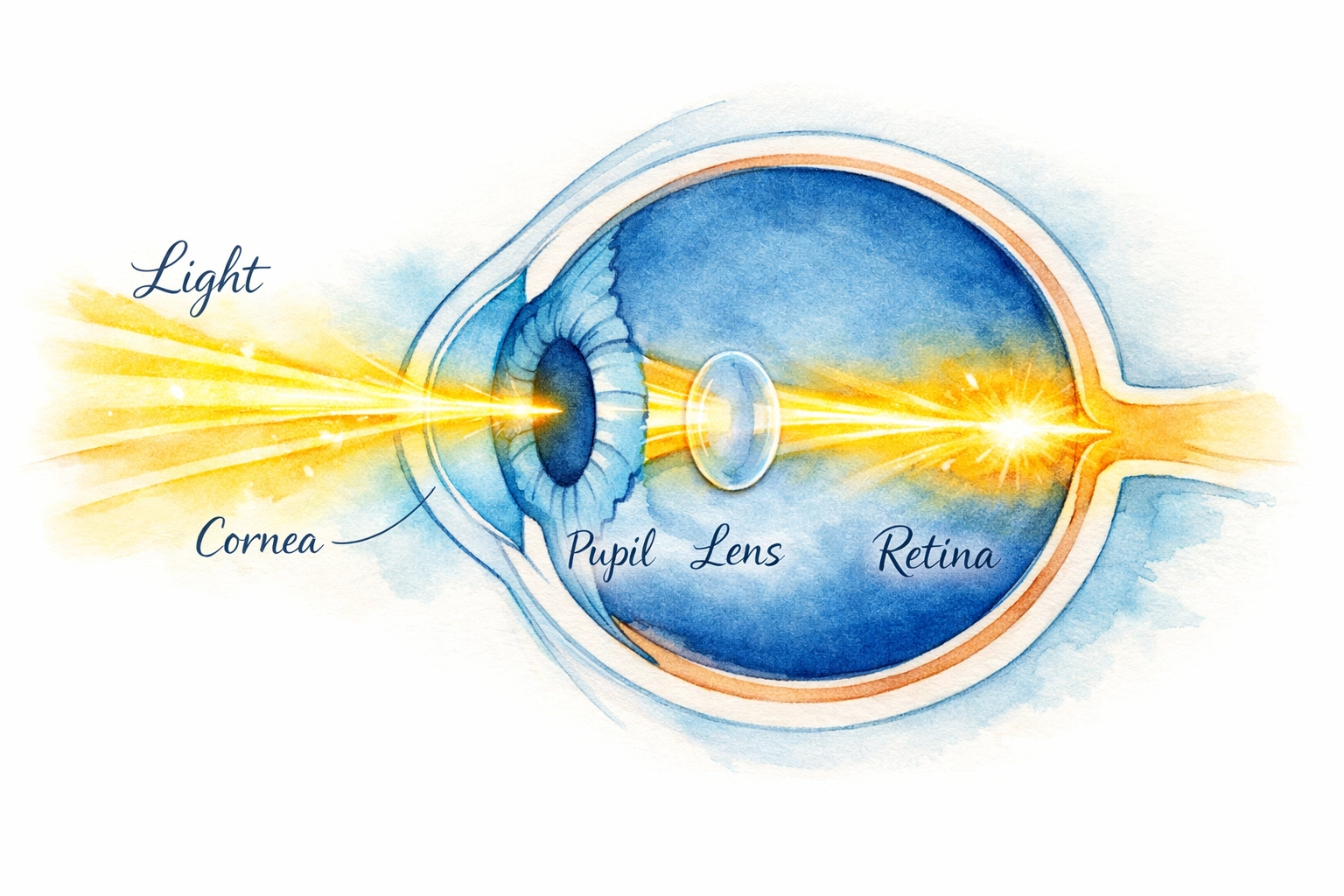
After passing through a clear, gel-like substance called the vitreous humour that fills most of your eyeball and helps maintain its shape, the light finally reaches the retina at the back of your eye.
And here's where it gets really wild.
The Retina: Where Light Becomes Sight
The retina is packed with specialized cells called photoreceptors: about 120 million rods and 6 million cones in each eye. These cells convert light into electrical signals. The rods help you see in dim light and detect motion, while the cones handle color and fine detail.
At the center of your retina is a tiny area called the macula, and within that is an even tinier spot called the fovea. This minuscule region: less than a millimeter across: is responsible for your sharpest, most detailed vision. It's what lets you read these words, recognize faces, and see the intricate details in everything around you.
All those signals from millions of photoreceptors then travel through your optic nerve: a bundle of over a million nerve fibers: to your brain, where the image is processed and interpreted.
And get this: the image that lands on your retina is actually upside down and reversed! Your brain automatically flips it right-side up without you ever knowing it happened.
All of this occurs in milliseconds, constantly, every moment you're awake.
The Impossibility of Chance
Now, I know some folks will say this all happened by chance, through millions of years of random mutations and natural selection. But when you really look at the complexity and precision required for vision to work, that explanation starts to feel pretty thin.
Consider this: all these parts: the cornea, pupil, iris, lens, retina, optic nerve, and brain processing centers: have to work together in perfect harmony. If you had a lens but no retina, you couldn't see. If you had a retina but no optic nerve, you couldn't see. If you had all the hardware but no brain to interpret the signals, you couldn't see.
The eye isn't just complex; it's what scientists call "irreducibly complex." All the parts need to be present and functioning together for the system to work at all. You can't build it piece by piece over time because the intermediate steps wouldn't provide any survival advantage: they simply wouldn't work.

This is exactly what we'd expect from an intelligent, purposeful Creator. God didn't just throw biological parts together and hope they'd somehow work. He designed a sophisticated optical system with precision engineering that puts our best human technology to shame.
A Window to the Divine
The Bible tells us that God's "invisible qualities: his eternal power and divine nature: have been clearly seen, being understood from what has been made" (Romans 1:20). The human eye is one of those clear testimonies.
When I look at the intricacy of the eye, I see the fingerprints of a God who cares about details. He didn't have to make our vision this good. He didn't have to create eyes that can detect millions of colors, adjust to different light conditions, focus on objects at varying distances, and work in coordination to give us depth perception. But He did.
God is a God of beauty, precision, and purpose. He's also a God who wants us to see: both physically and spiritually. Jesus said, "I am the light of the world. Whoever follows me will never walk in darkness, but will have the light of life" (John 8:12).
Just as He gave us physical eyes to see His creation, He offers us spiritual eyes to see His truth. And just as our physical eyes require all their parts working together to function, our spiritual sight requires all of God's Word working together in our hearts.
An Invitation to Wonder
Here's what I want you to take away from this: every time you open your eyes: which you do thousands of times a day without thinking about it: you're experiencing a miracle. You're using an organ so complex, so perfectly designed, that it points unmistakably to a Creator who loves you and made you with incredible purpose.
You're not an accident. You're not a cosmic fluke. You were designed by a God who cares enough to give you eyes that can see the sunrise, read His Word, recognize the faces of people you love, and marvel at the world He made for you.
That's the kind of God we serve: a God of details, beauty, wonder, and unfathomable creativity.
So the next time you look in the mirror and see your own eyes looking back at you, take a moment to thank God for the masterpiece of engineering that lets you see the world. And ask Him to open your spiritual eyes even wider, so you can see more of His truth, His love, and His purpose for your life.
You were created on purpose, for a purpose, by a God who sees you, knows you, and loves you beyond measure.
Go to the Boundless website and join the Bible Study Club. Connect with Christians around the world to discuss these studies, pray together, and grow closer to God and each other.
Need prayers? Text us day or night at 1-901-213-7341. Boundless Phone: 1-901-213-7341 FA Memphis: 1-901-843-8600 lmcdonald@famemphis.net - www.boundlessonlinechurch.org
Dr. Layne McDonald
Comments